Photography is an expensive hobby, everybody knows that. Why is that, when, with the advent of digital, a good film SLR and zoom or good standard lens can be had for very little money nowadays? Even DSLR prices have come down significantly. With digital, you don't even have film and processing costs. Why then?
The problem lies when the hobby turns into an obsession with gear. I have seen it happen over and over again. It is not a new phenomenon either. I remember, years ago, when I would read incessantly about which were "the best" lenses for XXX camera brand, there was always an oldtimer who proferred the admonition to "shoot with what you have" and that the search for the "best" lens was an expensive, futile quest, often leading back to where you started. Of course, I did not listen. I don't think anyone does. This circuitous quest is, I think, something most have to go through themselves.
The first stage is usually an obsession with brand. Canon makes the best digital sensors. Leica makes the best lenses. And so on. Everyone knows that, right?
At least back then, everyone started with a Pentax K1000. Then "upgraded" (a bad and expensive word) to Canon or Nikon. From there, the allure of German makers Contax/Zeiss and Leica.
The second stage is an obsession with specs. Camera specs. "This is a good entry level camera, then you can upgrade to a midlevel Nikon F100 once you decide what features you need." Well, what features do you really need? I know I need a shutter speed dial, an aperture adjustment ring, a shutter release, and ok, maybe even a meter. But at that stage, I spent hours poring over camera specs, to see if I should spend a little more and get mirror lock-up and 1000 zone matrix metering instead of "only" 200 zones. Inevitably, this is the stage of reading magazines like Pop Photo and Shutterbug.
So now you've got your camera and a decent kit zoom. Then you realize that your vacation photos don't look like those pictures in the National Geographic. You read more, this time on the internet, since the guys at Pop Photo favorably endorsed your kit zoom (what don't they?). Of course! I need a new lens. I need a "pro zoom." This is typically "fast" with an f/2.8 fixed aperture, covering the focal lengths I need from wide to telephoto, and weighs at least a pound.
Ok, now we are talking. At this stage, you now realize that you cannot possibly travel or go on a shoot without "covering" every possible focal length. So you buy a similarly fast superwide zoom, and an even heavier telephoto zoom. So now, you would have, typically, something like a 16-35/2.8, 28-70/2.8, and 80-200/2.8 (of course with IS or VR) in your bag.
You start experimenting with low-light shots and realize your pro zoom doesn't quite cut it. You need a fast prime lens. You start with a 50/1.8. Then another "upgrade" to a 50/1.4 for "those times when it is f/1.4 or no picture." You will hear this again and again in this "quest."
Wow, the narrow dof really makes a difference. You figure you need something similar for portraiture. An 85/1.8 is within your budget. Then an 85/1.4 or better yet, if you shoot Canon, an 85/1.2. For times when it is f/1.2 or no picture...
Same thing with wides. A 35/2 for shooting street. Then a 35/1.4. For indoors - a 24/2.8 becomes a 24/2, becomes a lusting for a 24/1.4.
Sharpness is king at this stage. The end-all and be-all. You are obsessed with MTF's. You spend hours looking at photos online, to see which lens is sharpest. 100% crops of corners.
Some will go on to a larger format.
You are taking pictures, mostly of the same subject, not because of the subject itself, but just to compare the lenses you have.
Then you figure, changing between the myriad lenses in your (now really heavy) bag can be a hassle. And what if the camera breaks? You need a "back-up" body. Typically, you also justify this by using different film in that body - maybe faster, maybe black and white, maybe both.
And there you are, with your big heavy bag full or pro equipment, shooting photos of your kid in the backyard. At least you have a back-up handy.
At this point in the game, you start wondering - "What makes Zeiss and Leica so special (read expensive)?" You decide you need an adapter, and go get some german lenses for your canon.
Then you find yourself intrigued by the whole "mystique" surrounding rangefinders. Usually this is because, at this level of being a "serious amateur" you start reading photography books. No longer the "how to" books you graduated to from Pop Photo. No. Now you are obsessed about the "decisive moment." You decide you need to be invisible and get more connected to your subject.
You have reached the zenith of technical gimmickry, and now you are on the downward spiral of ascetism. You shun lightmeters, preferring to guess the exposure by eye. You carry a cheatsheet in your pocket. Nosirree... just give me the basics - aperture, shutter speed, wind lever, focus and shutter release.
You wet your feet with a compact 35mm rangefinder. The Canonet GIII QL17 and Yashica GSN are popular choices. Not only is your photo sharper than your kit zoom, it may even be sharper than your heavy pro zoom. You are liberated by the experience. The simplicity.
"How can this 30 year old camera make sharper (usually 4x6 drugstore) prints than my plastic wondercamera (with the 1000 zone matrix meter and all-important mirror lockup)?" You get hooked on vintage equipment. They are much, much cheaper than your pro SLR equipment. Ebay becomes your friend. So does the mailman.
After you have gone through every possible cult fixed lens RF, you now decide you need interchangeable lenses. Russian Zorkis, Feds, and Kievs come next. The lenses are good! The bodies are unreliable. You move on to modern Voigtlander Bessas and vintage Canon rangefinders like the P. At this stage, you are reading internet sites like Karen Nakamura's and Dante Stella's, discovering the vintage cameras.
You find like-minded people online. "I am not alone in my gear lust." You buy and sell with your new friends. You feed each other's vices.
You spend a bit more money on your lenses. You progress from FSU to vintage Canon and Nikon RF lenses. Oh... the quality construction! The beautiful glass. Maybe Leica is better? An older LTM does not cost much more...
You hold your first leica lens. "Oh my God, now I understand."
You start accumulating standard lenses: Summitar, Summar, Elmar, Summarit.
You get an old Leica body - an inexpensive Barnack. Another "Oh my God" moment.
35's and 90's follow. And viewfinders.
Now you need a modern, reliable body. An in-camera meter "may" be useful, you concede. You are getting tired of the squinty finder, and accessory VF's. A bigger, brighter viewfinder is needed. And easier film loading than the barnack. A bessa.
From there, you decide to spend a bit more money, but Leica is too much. Best bang for the buck - CV lenses. More recently, another slightly more upscale choice was added - Zeiss Ikon.
From here, if you choose to continue on this quest, there is only one way to go: the Leica M.
You may start with an "inexpensive" lens, typically 50mm Summicron, to mount on your Bessa or other. Maybe an older collapsible or rigid. Then a more modern formulation. You "definitely see" the difference in your photos. The clarity, the "glow," the rendering, how it paints with light. The magic.
Or you may decide to start with an M body for your fast accumulating FSU, CV, and Canon/Nikkor glass. You probably start with an older one - M3 or M2. You hold your first M body. You wind the lever. You click the shutter. You almost pee in your pants.
"Oh my God."
From there, it gets bloody, $$ wise. Different focal lengths - 15, 21, 24, 35, 75, 90. You are hooked. You are shooting in low light, hand holding at obscenely slow speeds. You need faster - Summilux or faster. "For when you need f/1.4." Maybe a newer M body. More reliable, right? The older M becomes the back-up.
Hopefully, all this time, you have been shooting, and shooting. Learning. Improving your craft. You have also been honing your darkroom/photoshop/printing skills. Your photos are well-received, sometimes even admired. You may have even sold a few prints.
And then one day, it hits you. You wake up to the realization that your multitude of gear actually has been getting in the way of your development as a photographer. Much the same way as it would if Pete Sampras used a different tennis racquet every day. Or Schumacher drove a different car on each race.
"Less is more."
"You need to be one with your camera."
Zen.
So... you need to pare down your equipment. To keep only the best. The ultimate. But which one is "best?"
Another realization: there is no "best." Best is what works. What you are comfortable with. Which gives you the result you are after. Consistently. And since you have the luxury of being an amateur - best is what is fun, what gives you satisfaction.
Now you are shooting photos for what is IN the photo. You realize that the subtle differences between lenses that (usually only) you and your equally geeky online camera friends noticed are not really what is important. A lot of times you (and they) can't even tell these apart.
What I consider my "best" photo so far is a beautiful photograph. A lot of people admire it online, and even more love the print. Lovely light, beautiful subject, good composition. A case of being in the right place at the right time. Something non-repeatable.
I shot it with a plastic camera and a $60 zoom. With cheap ISO 200 drugstore brand color film. Processed in a 1-hour lab, scanned and converted to black and white on photoshop.
Many people assume I used a Leica camera and lens, and wax poetic... I have been too amused to correct them. I remember that as a lesson in what is actually important, and what are just foolish pretensions of gear fetishists.
A good photo is still a good photo even if shot with "lesser" equipment. Conversely, a poorly composed picture cannot be saved by a $2500 Asph lens. Try it - let your ten year old son shoot with your leica's (get insurance) and shoot with a Canonet. If your pictures suck, guess what, YOU suck.
You are still shaking your head? "A good photographer will make a better photo with better equipment" is another thing you will read on the internet. Usually on Leica forums. Ok, ask yourself:
a) Are you that good?
b) If you answered "yes" to a), do other people think you are good or is it just you?
c) Do you think Winogrand's photos would look better if, instead of an M4 + Canon 28/2.8, he used an MP + 28 Summicron Asph? How about if HCB used an Asph Lux instead of his collapsible summicron? Or Capa with a millenium Nikkor 50/1.4? Can you distinguish which shots Ralph Gibson took with a pre-ASPH vs ASPH Summilux, and if so, is one better than the other?
If you think "yes," you need to renew your subscription to Popular Photography.
Or maybe you are shaking your head because you think you are immune to this "disease?" A simple test: Ask yourself, if you won the lottery tomorrow, what one camera and lens would you buy? Enough said.
So what stage in this vicious cycle are you in? Are you coming, or going?
Of course, the usual disclaimer applies: YMMV. Your experience may be different, especially if you have will power and self-discipline. But I have seen this happen (to different degrees) enough times and at different levels to believe that this must be some rite of passage. After all, I don't think any "serious amateur" I know is still shooting (only) with his first camera (and has not "upgraded.")
A fun but expensive quest. And we didn't even get started with digital!
Just remember, like the holy cup, the "Grail" is within. YOU make the photos. But of course, you won't believe me. You will need to figure it out for yourself. I told you so.
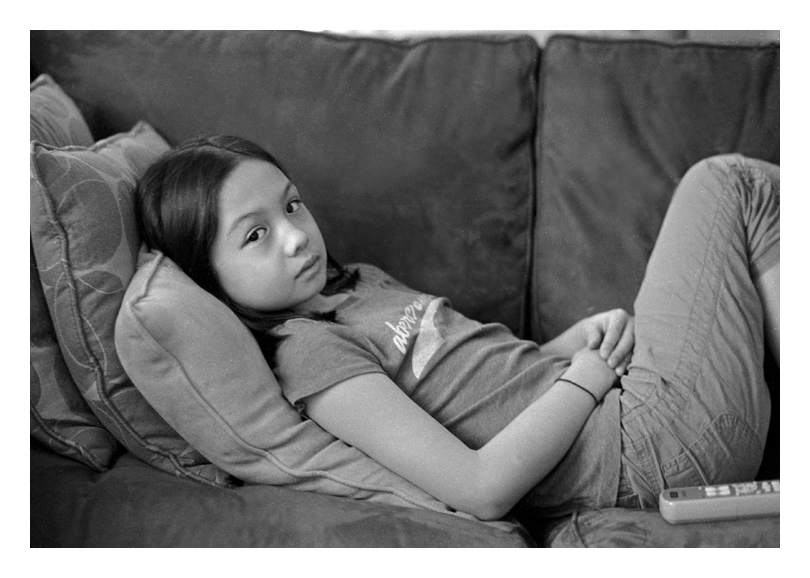
 I wish I had her eye for composition when I was 9.
 A very RARE picture of her daddy. Yes, that is snow on the beach.
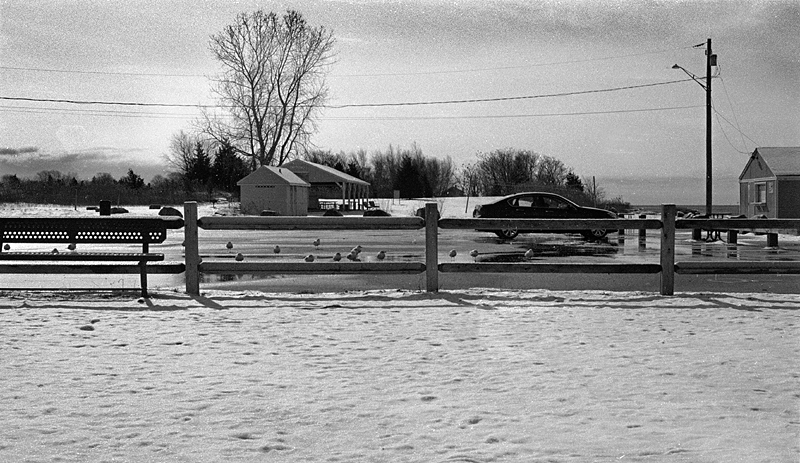 I wish I had her eye for composition when I was 9.
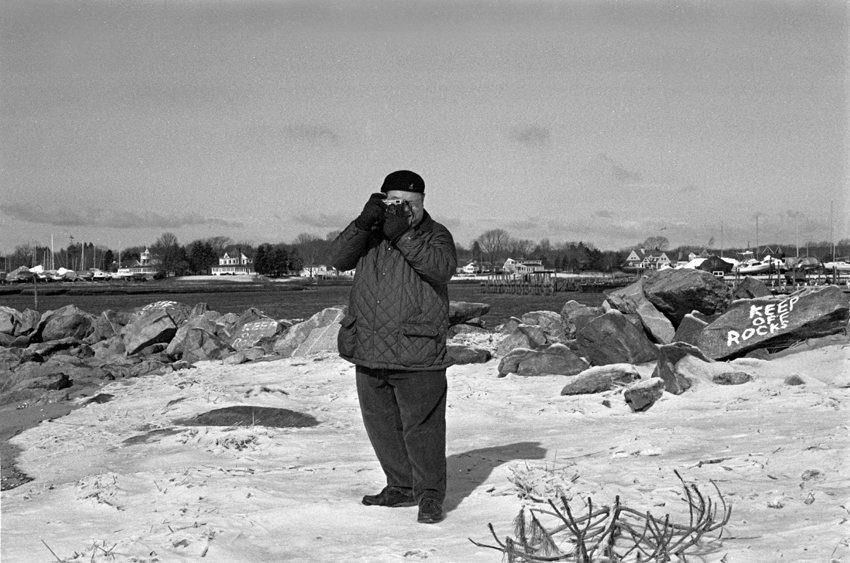 A very RARE picture of her daddy. Yes, that is snow on the beach.